
Halal Slaughter (HS) standards
Halal made transparent
Introducing the HS™ Standards
A New Era of Halal Transparency, Diversity, and Integrity 
Why are HS™ Standards Needed
1. The Problem: Need for clarity and transparency
- Confusion in contemporary terms used on labels such as Halal and Dhabiha/Zabiha (Halal slaughter) used loosely.
- No legal regulation of Halal slaughtering methods.
- This creates confusion and mistrust among Halal consumers.
2. Consequences: Misinformation and doubt
- Without clear and enforced regulations, misinformation proliferated.
- Producers, trade groups, accreditation bodies, and certifiers exploit vague standards for commercial gain.
- Consumers are left without reliable ways to verify Halal integrity.
3. Changing Realities: A Complex Landscape
- As politics, global trade, and food engineering evolved, so did the complexity of meat and poultry production.
- These changes introduced new challenges that traditional standards couldn’t address.
- The need for a transparent, inclusive, and religiously sound framework became urgent.
4. The Response: A Groundbreaking Solution
- ISA developed the HS™ Standards to restore religious integrity and empower informed choices.
- By recognizing valid diversity within Islamic law, the HS™ Standards offer clarity and accountability.
- The HS™ Standards are a work in progress to build transparency and clarity across the meat and poultry supply chain and requires continuous support and input from various Islamic organizations, consumers, business and trade.

ISA (Islamic Services of America) has developed a groundbreaking framework:
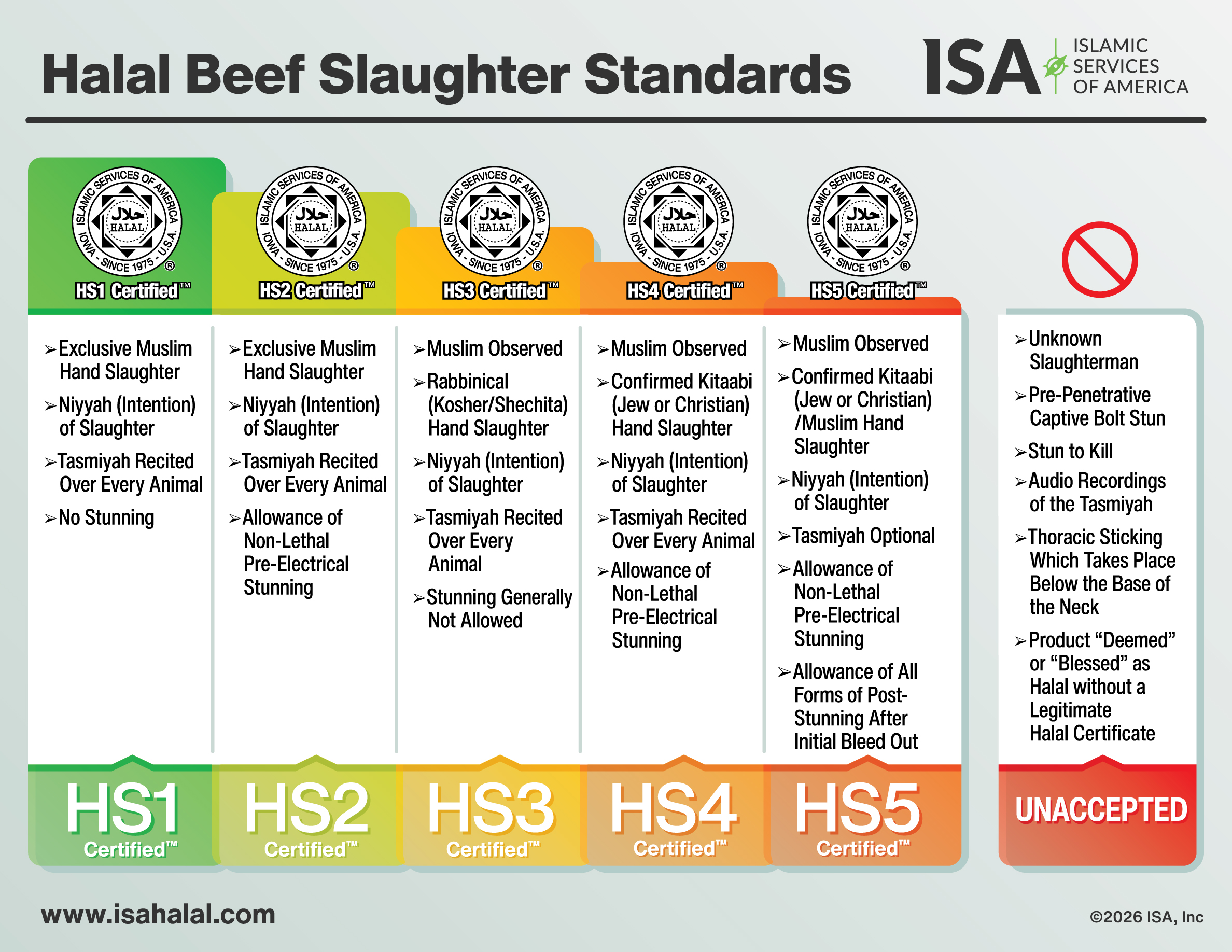
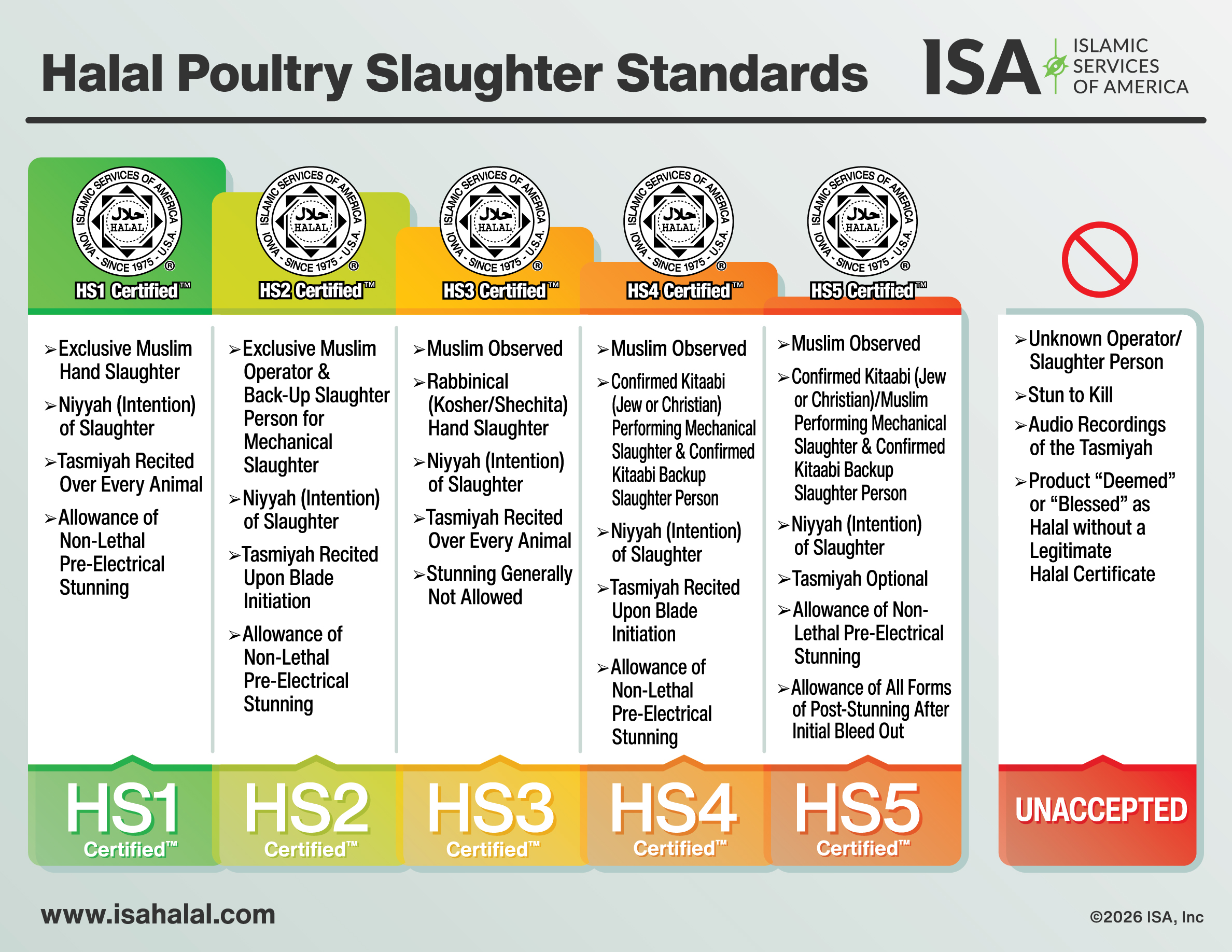
The HS™ (Halal Slaughter) Standards — a system of five distinct classes for both poultry and red meats, designed to represent the full spectrum of valid Islamic views and promote transparency across the Halal industry.
What Are the HS™ Standards?
The HS™ Standards empower Halal consumers and producers by:
- Recognizing multiple valid interpretations within Islamic law
- Offering clear classification of slaughter methods
- Promoting transparency in an industry often shrouded in secrecy
Each class is rooted in Islamic jurisprudence and designed to meet the ethical, religious, and practical needs of today’s diverse Muslim communities. 
Built on Strong Foundations
|
Foundation |
Description |
|
Classical Fiqh |
Opinions from Sunni schools of thought and renowned scholars |
|
Modern Fiqh Research |
Contemporary papers and resolutions from major Fiqh academies |
|
Animal Welfare Science |
Research on humane treatment and ethical slaughter practices |
|
Global Halal Standards |
Insights from international Halal certification bodies |
|
Technical & Economic Expertise |
Practical knowledge from industry professionals |

Introducing the HS Index
To support the adoption and understanding of the HS™ Standards, ISA presents the HS Index — a powerful market tool designed to bring clarity and accountability to Halal meat production in the United States.
What Is the HS Index?
The HS Index is a comprehensive database of meat and poultry slaughterhouses across the U.S., providing:
- Basic company and contact information
- Supervising Halal certification body
- Slaughter methods used
- HS Standard classification(s)
- Approximate daily slaughter volume
This tool empowers consumers, certifiers, and producers with the data needed to make informed, unbiased decisions about Halal meat sourcing. The HS Index is the standard bearer for the Halal industry in North America.

 Join the Movement
Whether you're a consumer seeking clarity, a certifier striving for integrity, or a producer aiming for compliance, the HS™ Standards and HS Index offer the tools to build a more inclusive, transparent, and trustworthy Halal future.
- Learn more about each HS classification
- Get certified with ISA
- Visit hsindex.com to explore the HS Index